
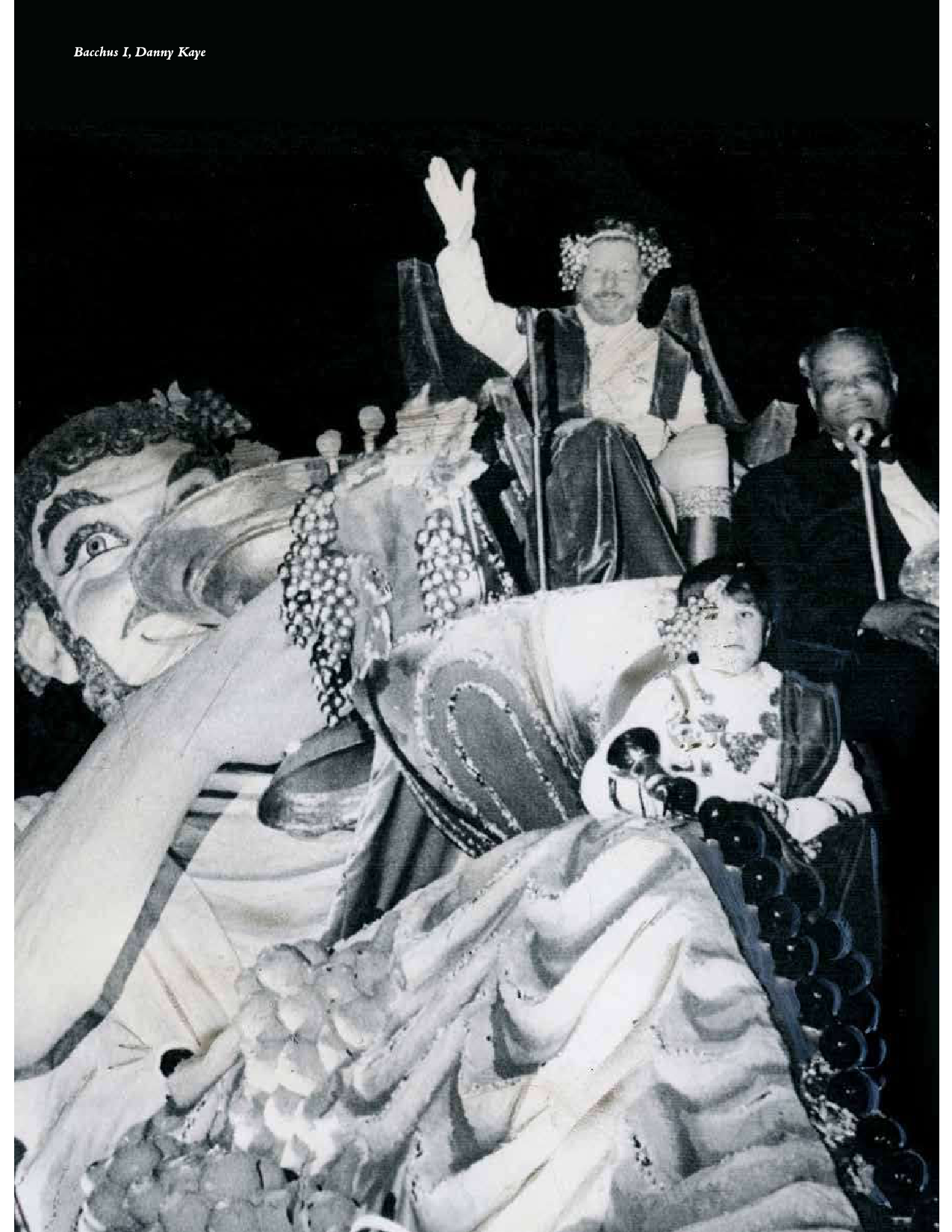
Bacchus I, Danny Kaye
Actor, singer, dancer, comedian, humanitarian, aviation enthusiast, and award-winning chef Danny Kaye (1913-1987) was the first to personify Bacchus for the Krewe. His red hair and tongue-twisting babbles were his trademarks. One of his more notable tongue twisters was “the pellet with poison is in the vessel with the pestle” from the 1956 movie The Court Jester.
Kaye was born in Brooklyn, New York, to Ukrainian Jewish immigrants. At age 13, Kaye worked the “Borscht Belt” of the Catskill Mountain Jewish resorts. In 1935 he joined a vaudeville
act, The Three Terpsichoreans, and toured the United States and Asia. While in Osaka, Japan, a typhoon hit the city and a falling piece of his hotel nearly killed Kaye. In an attempt to calm the non-English speaking audience that night, Kaye employed pantomimes, gestures, and exaggerated facial expressions, which would come to epitomize his work.
Kaye’s film debut occurred in 1935 in a comedy short Moon Over Manhattan, and his first feature film was Up in Arms released in 1944 in which Kaye played Danny Weems. Eventually, Kaye would appear in 24 films including Hans Christian Andersen (1952), White Christmas (1954), and The Court Jester (1956). Kaye’s Broadway debut was in 1939 with the comedy The Straw-Hat Review and the following year in the musical Lady in the Dark, which brought him critical acclaim.
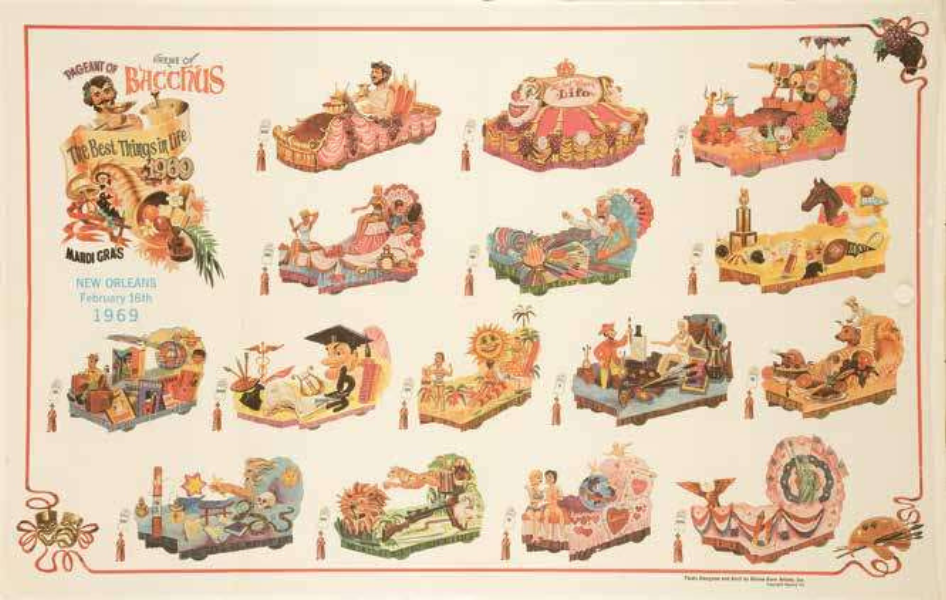
1969 Parade Bulletin
Kaye’s performance at the London Palladium “roused the Royal family to laughter” reported Life Magazine. In 1945 and 1946 he hosted The Danny Kaye Show on CBS radio, starring Eve Arden, Lionel Stander, and Harry James. Kaye entered television in 1956 with CBS’s Edward R. Morrow show See It Now and went on to host a CBS variety show The Danny Kaye Show from 1963 to 1967 winning four Emmys.
Kaye was the United Nations International Children’s Emergency Fund (UNICEF)’s first ambassador at large for which he conducted a comedic series of concerts on its behalf. He married Sylvia Fine in 1940 and became estranged in 1947 but never divorced.
While filming The Madwoman of Chaillot in Southern France, Kaye had grown a beard and came shortly after to New Orleans to reign as Bacchus I with a real beard. Proclaiming his role as Bacchus to be the greatest thing since peanut butter, Kaye insisted famed Hollywood designer Edith Head would make his costume, claiming she was the only person who knew how to fit him. Ella Brennan Martin recalled that she had a conversation with Head about his costume: “She called and said what about this costume and I said well, I will send you pictures of other kings and maybe you will get an idea. That’s all it was, a very pleasant arrangement.”
Kaye’s performance at the London Palladium “roused the Royal family to laughter” reported Life Magazine. In 1945 and 1946 he hosted The Danny Kaye Show on CBS radio, starring Eve Arden, Lionel Stander, and Harry James. Kaye entered television in 1956 with CBS’s Edward R. Morrow show See It Now and went on to host a CBS variety show The Danny Kaye Show from 1963 to 1967 winning four Emmys.
Kaye was the United Nations International Children’s Emergency Fund (UNICEF)’s first ambassador at large for which he conducted a comedic series of concerts on its behalf. He married Sylvia Fine in 1940 and became estranged in 1947 but never divorced.
While filming The Madwoman of Chaillot in Southern France, Kaye had grown a beard and came shortly after to New Orleans to reign as Bacchus I with a real beard. Proclaiming his role as Bacchus to be the greatest thing since peanut butter, Kaye insisted famed Hollywood designer Edith Head would make his costume, claiming she was the only person who knew how to fit him. Ella Brennan Martin recalled that she had a conversation with Head about his costume: “She called and said what about this costume and I said well, I will send you pictures of other kings and maybe you will get an idea. That’s all it was, a very pleasant arrangement.”
Mission accomplished. Bacchus would become the standard by which future krewes would be gauged.
Bacchus, The Golden Anniversary
Bubbly Bacchus
Co-Captain Pip Brennan convinced Kaye to allow Larry Youngblood to design the royal wardrobe. Youngblood told Kaye, “I’m sure you’re going to like what I do for you, Mr. Kaye.” Kaye responded, “I’m not sure about that, but I hope I can have an electric blanket on the float.” Youngblood responded, “I wouldn’t know.” Kaye retorted, “I hope there’s a place I can plug it in.” Youngblood said, “I can think of several.” Kaye’s costume had plenty of room for thermal underwear in lieu of an electric blanket and he would later speak well of Youngblood’s costume design to Edith Head. It was in fact a cold night. Ella recalled her conservation with Kaye: “He told me it’s freezing out there, and I do remember it being one of the coldest nights I have ever spent in New Orleans, and so his hands were freezing. So, I said y’all go hunting (to the men helping him). Don’t you have those hand warmers? Well finally somebody got a store open and they gave him hand warmers.” She also recalled that when he passed her on the balcony at Brennan’s restaurant he yelled to her, “I’m freezing.”
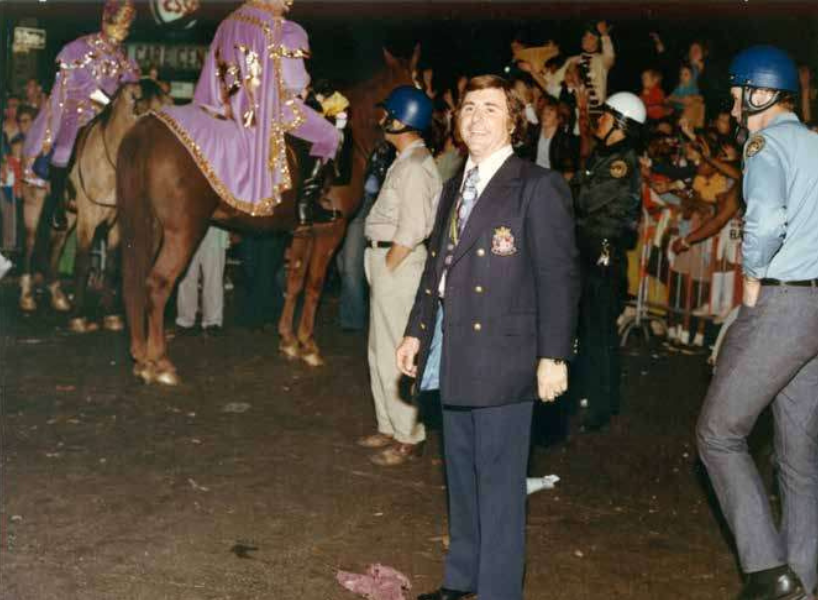
Kaye said the reason he came to New Orleans was simple, “I was asked to come. I was sitting at home minding my own business when a delightful lady named Ella (Brennan) Martin called. Ella asked me to be king. And I said, What’s that? It all boils down to this—that she wouldn’t take no for an answer.” Kaye regretted that his commitments would prevent him from staying through Fat Tuesday. “Anyone who comes to New Orleans for one day has got to be some kind of nut,” Kaye proclaimed. Ella recalled in 2017 how she met Kaye.
“I met him over the years from Marilyn Barnett. Marilyn was the P.R. director for the Roosevelt Hotel and they had him, I think, at the Blue Room. Yes, I’m sure it was the Blue Room and she brought him by (the restaurant). She introduced him to me and we became, over the years, friends. His daughter Danna is still a dear friend.” She also recalled in more detail than Kaye how she got him to be Bacchus: “I called him on the phone, I believe, and he said tell me what this is all about and I told him the whole story, what was being organized and what it was, and so he said I am going to fly down for lunch. So, he came down and spent the weekend here, and I told him all about Mardi Gras and he said, ‘OK, OK, I’ll do it, I’ll do it, but I will not wear tights.’ So, I told the troops…Well, low and behold it comes the night (of the parade), and they were getting him to get dressed and out comes the tights and you should have heard the yelling and screaming up and down the halls of the Royal Orleans, but he put them on.”
Kaye said the reason he came to New Orleans was simple, “I was asked to come. I was sitting at home minding my own business when a delightful lady named Ella (Brennan) Martin called. Ella asked me to be king. And I said, What’s that? It all boils down to this—that she wouldn’t take no for an answer.” Kaye regretted that his commitments would prevent him from staying through Fat Tuesday. “Anyone who comes to New Orleans for one day has got to be some kind of nut,” Kaye proclaimed. Ella recalled in 2017 how she met Kaye.
“I met him over the years from Marilyn Barnett. Marilyn was the P.R. director for the Roosevelt Hotel and they had him, I think, at the Blue Room. Yes, I’m sure it was the Blue Room and she brought him by (the restaurant). She introduced him to me and we became, over the years, friends. His daughter Danna is still a dear friend.” She also recalled in more detail than Kaye how she got him to be Bacchus: “I called him on the phone, I believe, and he said tell me what this is all about and I told him the whole story, what was being organized and what it was, and so he said I am going to fly down for lunch. So, he came down and spent the weekend here, and I told him all about Mardi Gras and he said, ‘OK, OK, I’ll do it, I’ll do it, but I will not wear tights.’ So, I told the troops…Well, low and behold it comes the night (of the parade), and they were getting him to get dressed and out comes the tights and you should have heard the yelling and screaming up and down the halls of the Royal Orleans, but he put them on.”
Inaugural Ride
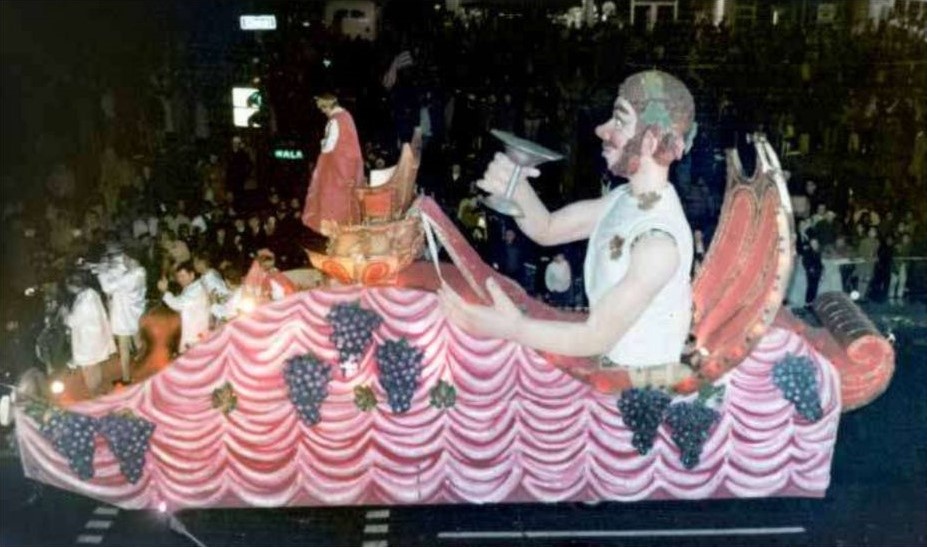
Bacchus I’s Royal Float on Canal Street on that cold Sunday night February 16, 1969. Danny Kaye tossed doubloons to the crowd as he led a 15-float procession carrying 250 men.
Ready, Set, ROLL!
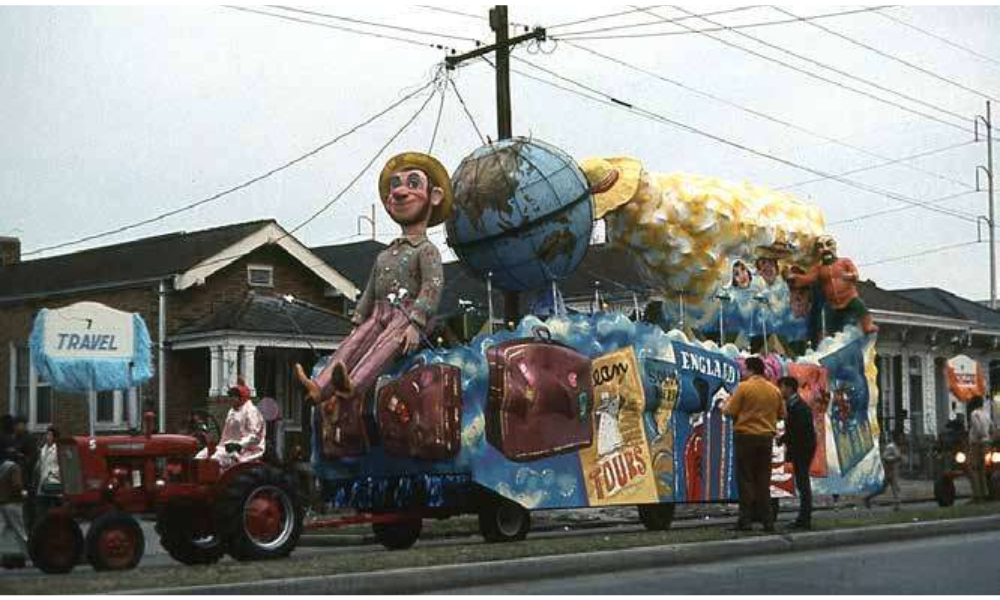
The inaugural parade lining up on Jackson Avenue
Theme: The Best Things in Life
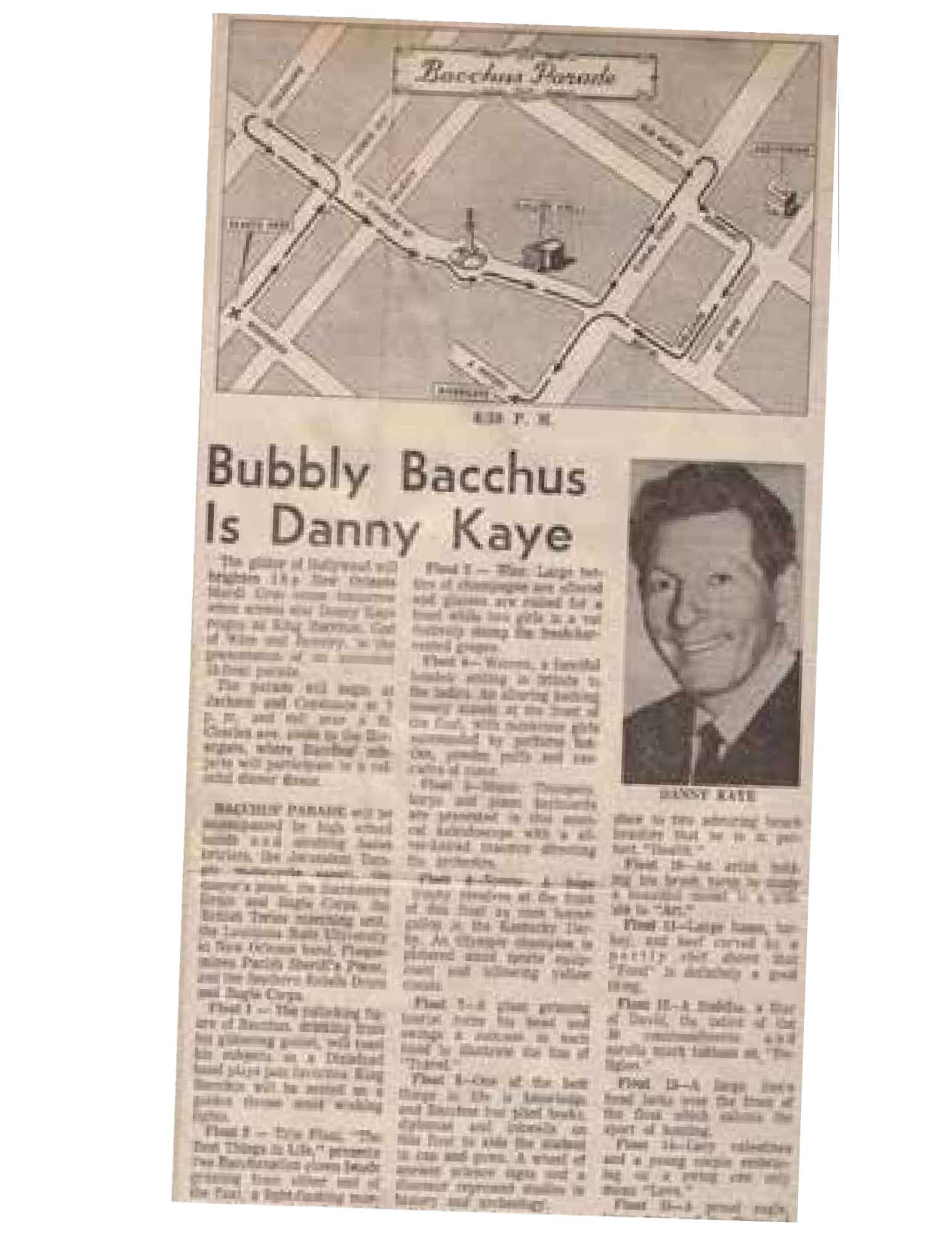
For his reign Kaye announced, “I proclaim there be unbounded love and laughter.” He led the inaugural Bacchus parade in 1969 with a theme of The Best Things in Life. It was a chilly brisk night but the crowds were tremendous. He broke another Carnival tradition, instead of waving a scepter, he tossed doubloons and beads to the crowd who loved it. Bacchus’s break with Carnival tradition was well received by the press and the public. At 7:00 P.M. after a brief delay due to some float lights not working, the parade began on Jackson Avenue and Rousseau Street, the traditional parade starting point, travelled the traditional route to St. Charles Avenue initially going upriver, where it U-turned at Toledano Street, then traveled downriver to Canal Street. On Canal Street, the parade travelled lakeward to Elk Place, then U-turned heading towards the river. Here the route broke with tradition. The parade then turned onto North Rampart Street, where at Orleans Avenue it headed into the French Quarter, turning on to Royal Street, passing Brennan’s restaurant, the opposite direction from most parades. On Royal Street, the parade travelled back to Canal Street terminating at the Rivergate at the foot of Canal Street for its Rendezvous.
Charter Bacchus member Dr. Robert Cangelosi recalls, “Kaye was the best Bacchus we ever had. He was spectacular! He loved kids and worked for UNICEF. They had a throne for him and kids from all around the world at the Rendezvous. Kaye sat with the children on the floor instead of his throne. Kaye had his own plane and paid for his own travel to New Orleans and asked Bacchus to give the funds they would have paid for transportation to UNICEF.” Ken Smith, a charter member, agreed that Kaye was spectacular and one of the Krewe’s best kings. Co-Captain Dick Brennan’s wife Lynne recalled, “Well, I remember he came in thinking the king of Bacchus was supposed to be like Nero and would fling his cape around and everything…but when he got up on that float and he saw those millions of people screaming for him, the ego came out and he absolutely had the most wonderful ride in the world because he had no idea he would be so honored and so looked up to. It was fun to watch human nature.” Raymond Burr, Bacchus II, said of Kaye’s reign, “Oh boy, did he have fun. He told me there had never been anything like it in his whole life.”
Kaye was not the only celebrity to ride in Bacchus’s inaugural parade. New Orleans native Ed Nelson rode and would return on a regular basis and would help the Krewe obtain future Bacchuses such as Bob Hope, Charlton Heston, and Perry Como. Nelson was best known for his role as Dr. Michael Rossi in the ABC show Peyton Place from 1964 to 1969. Also riding was trumpeter Al Hirt and the New Orleans Saints owner John Mecom Jr.
The Rivergate
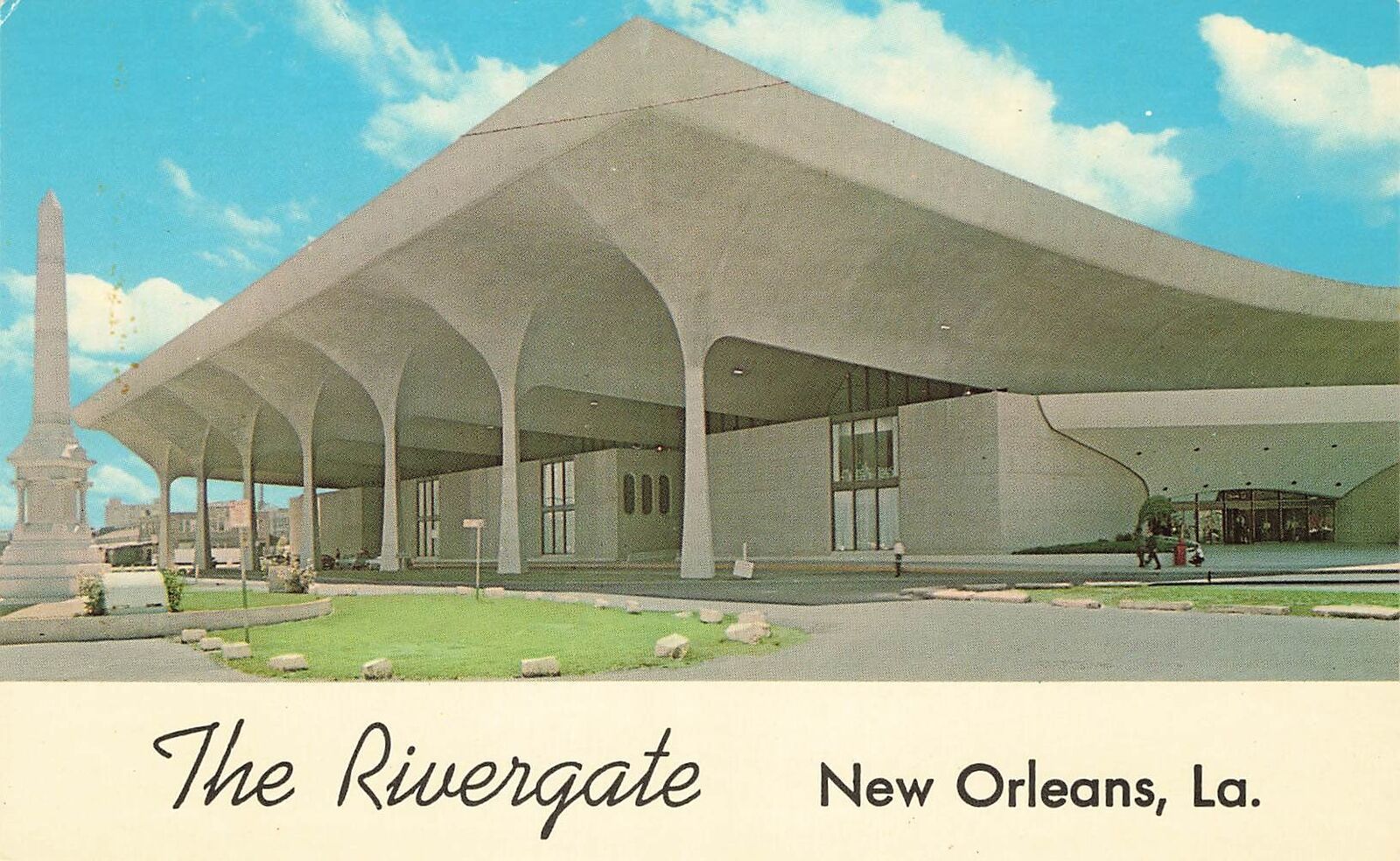
The Rivergate was home to the Bacchus Rendezvous from their first parade through 1976 when the krewe moved the event to the new Louisiana Superdome
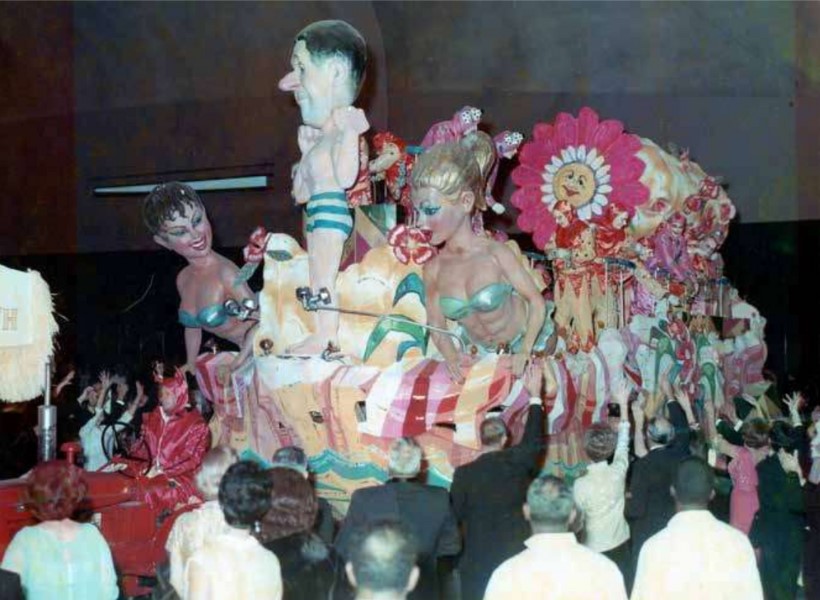
First Rendezvous
1969 theme float “Health” in the Rivergate for the Rendezvous
The parade consisted of 15 floats carrying approximately 250 men. The parade’s King’s float broke with tradition by not being a royal throne, but an animated Bacchus bust with a head made in Viareggio, Italy. Bacchus was a 1960s hippie with mutton chop sideburns and a moustache. There was also space on the float for a band to perform for Bacchus.
Following the royal float was the title float with two Bacchanalian clowns announcing the theme. The third float was entitled “Wine” with large bottles and girls stomping grapes. The next float was entitled “Women” featuring a boudoir of bathing beauties, perfume, roses, and powder puffs. Float five was “Music” with a maestro conducting a symphony of trumpets, harps, and pianos. “Sports” was the theme of float six and featured the local teams of the NFL—Saints and the ABA Buccaneers. Float seven had a grinning tourist carrying suitcases and was titled “Travel.” The next floats were “Knowledge,” “Health,” “Art,” “Food,” “Religion,” “Honesty,” “Love,” and “Patriotism.” “Knowledge” featured books, diplomas, and ink wells; “Health” had a large muscle man; “Art” featured a menagerie of artists, brushes and frames; “Food” depicted ham, turkey, vegetables, and a steer’s head; “Religion” had African fetishes, the star of David, the ten commandments, and Christian symbols; “Hunting” had a lion’s and leopard’s heads; “Love” had Valentine hearts; “Patriotism” had stars and stripes; Uncle Sam, cannon and, fireworks.
The float animation was provided for years by New Orleans Boy Scouts aged 11-17 years. Two scouts were assigned per float. Not being costumed the scouts had to remain out of sight from the crowd. Often, they were positioned under the float, which presented a problem because they were subject to fumes from the tractor pulling the float. After one scout was nearly overcome from the fumes, the tractor exhaust was changed.
The first parade was designed by Joe Barth, working for Kern. Joseph Edward Barth Jr. (1925-1996) was a graduate of Warren Easton High School and the John McCrady Art School. Barth worked in commercial art, interior design, and theatrical scenery, as well as Carnival float design. During the Great Depression, his interest in Carnival blossomed. After World War II, he independently worked for various krewes as well as for the New Orleans Recreation Department doing theatrical scenery. From 1964 to 1974 Barth worked for Blaine Kern before opening Barth Brothers in 1975 to build floats he and his brother designed and large sculptures such as the gates for the 1984 Louisiana World Exposition. Bacchus did revive for its first parade the Carnival Bulletin, which had practically disappeared, illustrating the parade floats using Barth’s sketches. Krewe members were given a preview of the floats at an open house, which would become an annual tradition. Dickie Brennan, who was a page for the first parade and son of Co-Captain Dick Brennan, recalled how exciting that first preview was for a seven-year-old. He said the band was playing and out came Louis Prima to sing to the Krewe.
The parade went into the Rivergate Convention Center where 1,600 guests awaited and as promised there was no tableaux ball, but lots of eating, drinking, and dancing by all in attendance. Pip Brennan recalled that inaugural trip into the Rivergate: “Oh man, that blew my mind! It blew everybody’s mind. No one ever dreamed of bringing a parade into the Rivergate. It was unbelievable, and it was jammed to the rafters.” Ken Smith recalled that although it was a large facility, the vaulted ceilings and the lighting made it feel warm and welcoming and that there were music venues through the facility that first year. Lynne Brennan recalled, “It was spectacular. It was really truly the most exciting event to witness…I mean going to a supper dance and having your mouth open, seeing (so many) people like this. They had everybody involved, and you could buy a ticket to the supper dance and outsiders could come…I will never forget when the first float came in with Danny Kaye, it was just electrifying. It was absolutely incredible. It was the first time this had happened.” The dinner menu was shrimp cocktail, green salad, Cornish hen with wild rice stuffing, baked stuffed potatoes, peas, and rolls. The Ralph Flanagan Orchestra played for the guests who had a wonderful time at the Rendezvous which lasted until 2:00 A.M. Flanagan was a famed big band leader whose band had a Glenn Miller sound.
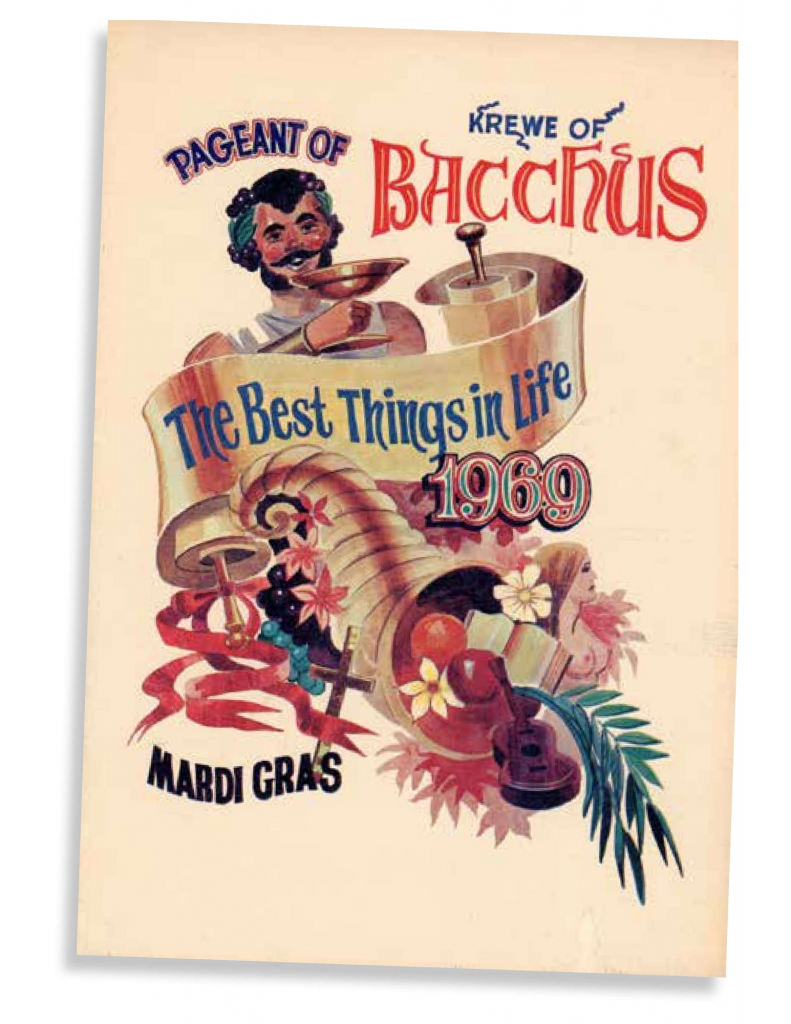
Read All About It!
Bacchus Fulfills Promise with Big Animated Floats
 Upon Kaye’s death in 1987, Captain Pip Brennan remembered Kaye’s reign, “He was great, he was a beautiful guy. He related well to the people. We had a great, great first king in Danny Kaye. He brought it off well. It was like he was on stage. We could not have had a better King and no one since has been better.” The krewe sponsored a champagne brunch honoring Kaye benefiting UNICEF entitled, “Helping Children of the World” at the Sheraton Hotel, which co-sponsored it on November 1, 1987.
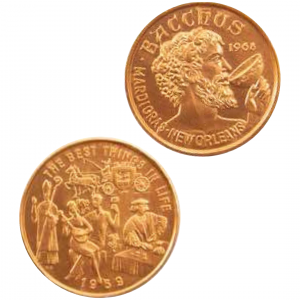
Bacchus would become known for the quality and quantity of its throws. The club’s initial parade doubloons sold at the following prices: .999 silver for $8 each, silver oxide for $3, antique bronze for $2.50 and a bag of 100 aluminum for $6.
Co-Captain Pip Brennan recalled in later years, “The first parade was everything we dreamed that it would be…The excitement was unbelievable.”
Upon Kaye’s death in 1987, Captain Pip Brennan remembered Kaye’s reign, “He was great, he was a beautiful guy. He related well to the people. We had a great, great first king in Danny Kaye. He brought it off well. It was like he was on stage. We could not have had a better King and no one since has been better.” The krewe sponsored a champagne brunch honoring Kaye benefiting UNICEF entitled, “Helping Children of the World” at the Sheraton Hotel, which co-sponsored it on November 1, 1987.
Bacchus would become known for the quality and quantity of its throws. The club’s initial parade doubloons sold at the following prices: .999 silver for $8 each, silver oxide for $3, antique bronze for $2.50 and a bag of 100 aluminum for $6.
Co-Captain Pip Brennan recalled in later years, “The first parade was everything we dreamed that it would be…The excitement was unbelievable.”
The brash newcomer had promised the biggest floats ever—bigger than Rex—and some exciting ideas in animation. Bacchus didn’t exaggerate. The floats were outstanding…In many sections, the crowds were so interested in watching the huge animated floats and admiring the costumes, that the traditional scramble for beads and doubloons was considerably subdued…In fulfilling its promise to create a new and better Carnival parade, Bacchus also broke tradition by having Kaye, a non-resident of New Orleans as its King.
The day after the parade, the Times-Picayune recorded under the headline “Bacchus Fulfills Promise with Big Animated Floats”
Read All About IT!
One of the most interesting parades was that of Bacchus on Sunday evening, when Danny Kaye presided as King Bacchus on a pink float. This parade has several firsts—it is the first time that an “outsider” instead of a resident has been chosen king of a parade and animated floats were used. On Kaye’s float, the huge head of Bacchus was featured, with his arm raising a golden champagne glass to the head of the facsimile of the King of Bacchus. The usual sheriff’s posse on horseback, innumerable high school bands and drum and bugle corps, and floats comprised the parade.
Marion Wilke
writing for the Rockford Illinois Morning Star wrote of the inaugural parade in an article entitled “Mardi Gras City Glitters”
Change came slowly but dramatically. Almost dying from hardening of the arteries, Carnival was revived in 1968 with the creation of the Krewe of Bacchus, a new club with fresh ideas for a 20th century Mardi Gras. The catalyst was the appearance of the Bacchus parade…History was made that night. Mardi Gras in New Orleans has never been the same.
Baton Rouge Advocate
In 1978, they wrote of Bacchus’s inaugural parade changing Carnival forever
After viewing the majority of Carnival parades this season (1969), I have concluded that the newly-formed Krewe of Bacchus was indeed the finest organization to ride the streets of New Orleans. Bacchus pageantry and many new innovations (including large floats, imaginative animation, clever lighting effect) created a spirit of excitement and enthusiasm. My hope is that Bacchus will continue to do the same each year.”
Russell Graham
In a letter to the editor of the Times-Picayune
Bubbly Bacchus
For years, the Boston and Pickwick Clubs on Canal Street were dark in protest over Bacchus’s breaking Carnival tradition. Pip Brennan recalls that the Carnival royalty rehearsing for their upcoming balls were hanging out the club’s windows to steal a view of the parade. The Boston Club would not turn on its lights until Bob Hope reigned as Bacchus in 1973. Rex Captain Darwin Fenner asked Bacchus if the Boston Club could toast Bob Hope at the club; Co-Captain Brennan respectfully declined due to scheduling. Subsequently “Bacchus Night” at the Boston Club was one of its most popular Carnival nights.
“When we turned from St. Charles to Canal Street the crowds were unbelievable,” Dr. Cangelosi recalled. “The floats coming up Royal Street were fantastic.” Charter member Sal Federico recalls, “Riding on Canal Street was a thrill but St. Charles Avenue was always my love, and, of course, when we first started, we would go down in the Quarter. It was wonderful because it was so close, you were right there. It was a lot of fun, and going into the Rivergate was a thrill.” Charter-member Dr. George Dimitri recalled riding through the Quarter for the first time: “That was really fun. It was narrow. You had people on the balconies and we would throw beads up there. There were so many people there, but on a small street. We had a lot of fun. People were just backed up on the buildings.
Pip Brennan remembers, “It was so exciting. You could almost shake hands with the people on the balconies.” Charter member Leon Rittenberg Jr. recalled that inaugural night, “Of the first parade. I remember coming down the Avenue (St. Charles), Canal Street, but I liked the Quarter…I remember seeing a bunch of people on the Moss balcony (413 Royal Street). We stopped there. I could practically reach over and touch Andre (Moss) because we were so close and the floats were so big and so tall and so close to the balcony.”
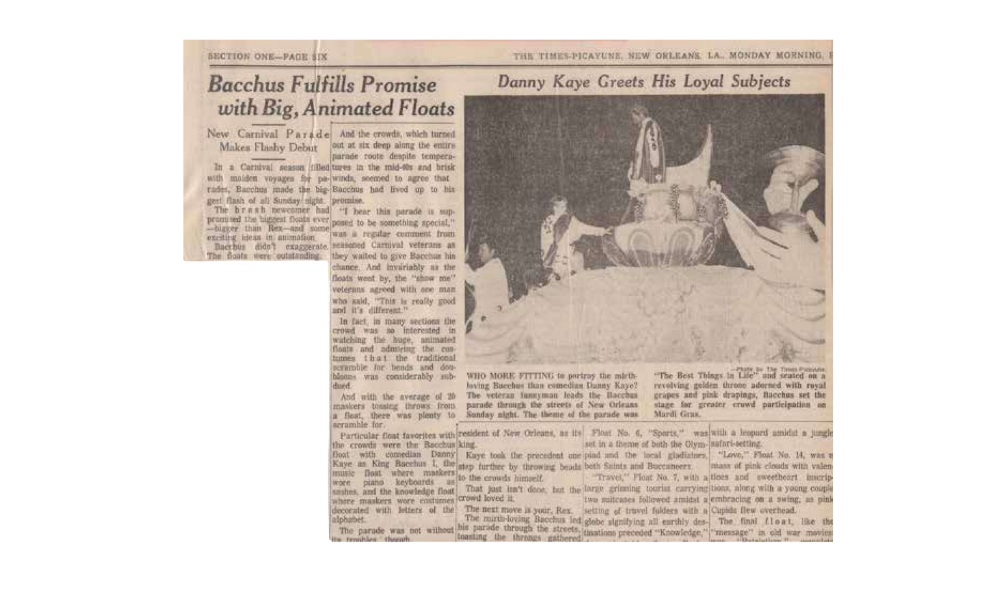
Bacchus Fulfills Promise with Big, Animated Floats
Danny Kaye Greets His Loyal Subjects
Of that first parade Ella Brennan Martin who was on the balcony of Brennan’s restaurant recalled: “Well it was extraordinary. It was fabulous. I mean the floats were big and Danny was King. It was absolutely a magnificent vision…and they had the wonderful lights, the flambeaux. I can picture it in my mind right now. The floats were as high as the balcony and you felt so close you could reach out and shake hands.”
Lynne Brennan recalled of that parade: “I will never forget it. Dickie (Brennan) and Owen (Brennan III) were pages, I think Dickie was seven and the night Bacchus came about, it was so unexpected, the crowds were like multitudes of people, cars and everything and we couldn’t get the limousine to pick up the kids to go to the float. So, I remember Barbara (Brennan, wife of Pip Brennan) and I put them on two-wheel bikes and peddled them down to Jackson Avenue where it started and put them on the float. I mean it was hysterical. When the float came by city hall (Gallier Hall) and I saw my seven-year-old son standing on a platform with a rope around him. I thought Oh my God! If we live through this it will be a miracle.”
Lynne Brennan recalled: “I can remember Barbara and I being on a stand in the Rivergate and almost having our clothes torn off by people who wanted to see Danny Kaye. There were a couple of policemen there that held them off (of us).”
In a 1994 WDSU television segment on the Krewe’s impact on Carnival, Alec Gifford said that Bacchus is “an organization that brought Mardi Gras from blue bloods to new blood, from monarchy to democracy.” And “Ever since Bacchus launched that first parade in 1969, there has been a pretender in the (Carnival) palace whose blood does not have to be blue, whose money does not have to be old and who does not even claim to be a king, he does however claim to be a god. The god of wine, a fun-loving deity named Bacchus.” In the segment, Mel Leavitt, who covered the first parade from WDSU’s balcony on Royal street, said that they were not sure the broadcast would even happen because of objections from the krewe of Rex. Leavitt said, “I could almost see the door to the future open and by gosh it did. It went open that night. What they did was to help democratize Carnival. It was not a krewe that was socially oriented and restricted to just a few or one particular set—Anglo-Saxon WASPS in many cases—the old line…I guess one of the marvelous little touches was that the first king—if you will—the god Bacchus was Jewish. The man upfront leading the parade, Danny Kaye, was not only Jewish, but the great symbol of international understanding of love.” As Gifford concluded the segment he added, “As Mardi Gras moves towards the end of the 20th century more alive and well than ever, most would agree thanks in large means to Bacchus.
Of that first parade Ella Brennan Martin who was on the balcony of Brennan’s restaurant recalled: “Well it was extraordinary. It was fabulous. I mean the floats were big and Danny was King. It was absolutely a magnificent vision…and they had the wonderful lights, the flambeaux. I can picture it in my mind right now. The floats were as high as the balcony and you felt so close you could reach out and shake hands.”
Lynne Brennan recalled of that parade: “I will never forget it. Dickie (Brennan) and Owen (Brennan III) were pages, I think Dickie was seven and the night Bacchus came about, it was so unexpected, the crowds were like multitudes of people, cars and everything and we couldn’t get the limousine to pick up the kids to go to the float. So, I remember Barbara (Brennan, wife of Pip Brennan) and I put them on two-wheel bikes and peddled them down to Jackson Avenue where it started and put them on the float. I mean it was hysterical. When the float came by city hall (Gallier Hall) and I saw my seven-year-old son standing on a platform with a rope around him. I thought Oh my God! If we live through this it will be a miracle.”
Lynne Brennan recalled: “I can remember Barbara and I being on a stand in the Rivergate and almost having our clothes torn off by people who wanted to see Danny Kaye. There were a couple of policemen there that held them off (of us).”
In a 1994 WDSU television segment on the Krewe’s impact on Carnival, Alec Gifford said that Bacchus is “an organization that brought Mardi Gras from blue bloods to new blood, from monarchy to democracy.” And “Ever since Bacchus launched that first parade in 1969, there has been a pretender in the (Carnival) palace whose blood does not have to be blue, whose money does not have to be old and who does not even claim to be a king, he does however claim to be a god. The god of wine, a fun-loving deity named Bacchus.” In the segment, Mel Leavitt, who covered the first parade from WDSU’s balcony on Royal street, said that they were not sure the broadcast would even happen because of objections from the krewe of Rex. Leavitt said, “I could almost see the door to the future open and by gosh it did. It went open that night. What they did was to help democratize Carnival. It was not a krewe that was socially oriented and restricted to just a few or one particular set—Anglo-Saxon WASPS in many cases—the old line…I guess one of the marvelous little touches was that the first king—if you will—the god Bacchus was Jewish. The man upfront leading the parade, Danny Kaye, was not only Jewish, but the great symbol of international understanding of love.” As Gifford concluded the segment he added, “As Mardi Gras moves towards the end of the 20th century more alive and well than ever, most would agree thanks in large means to Bacchus.