Hey, this is fantastic…You people do this every day?
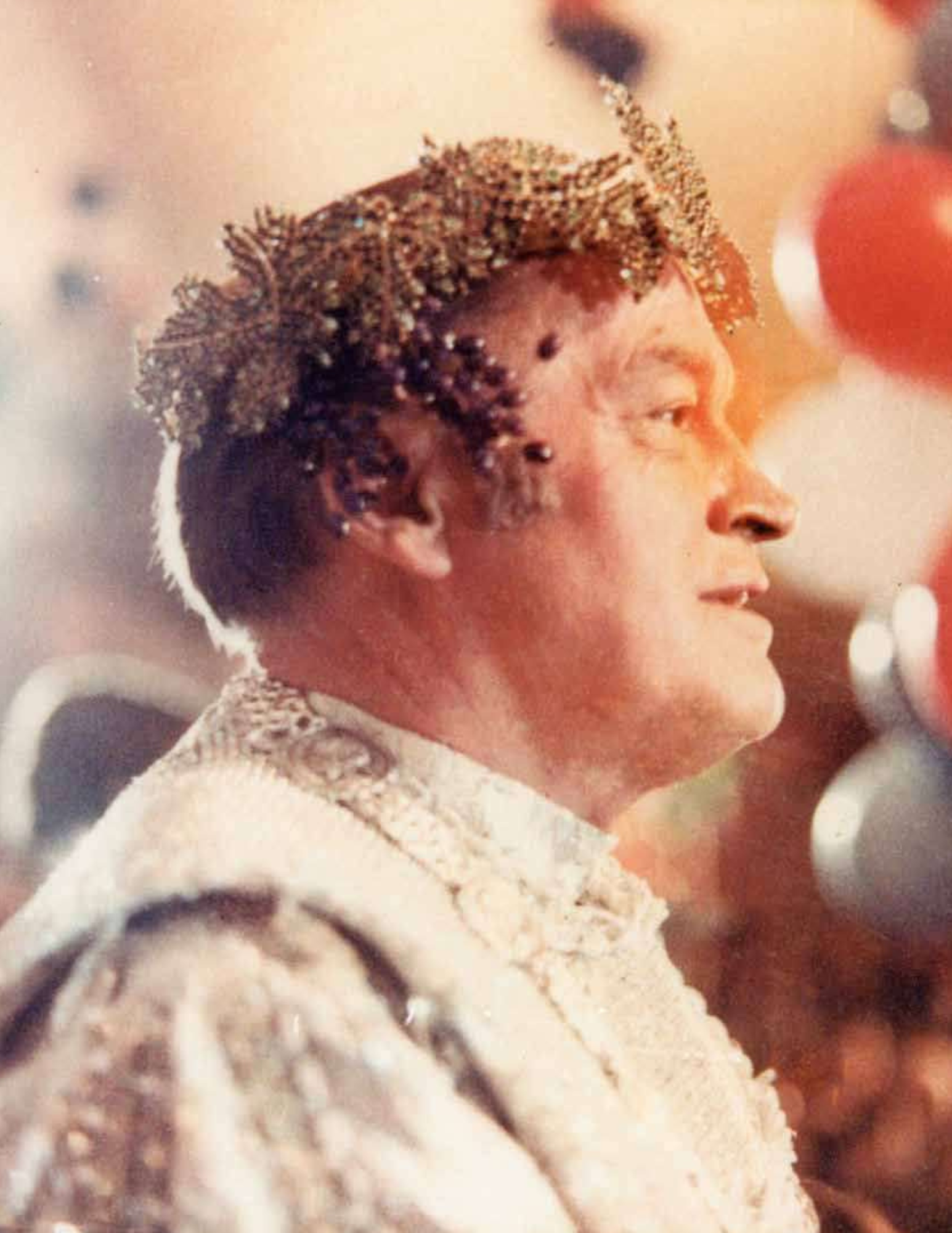
Bob Hope, Bacchus V

Bacchus V, Bob Hope

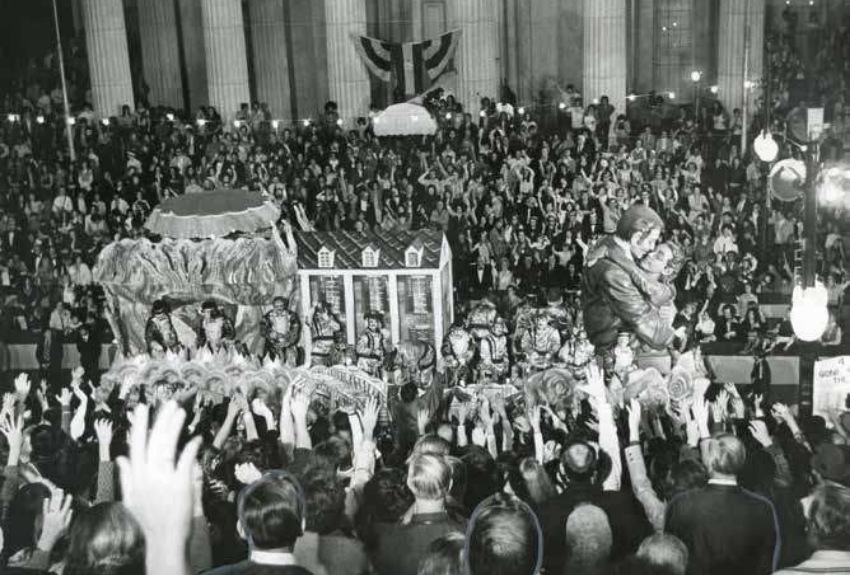
For the 1973 parade on March 4, the weather was perfect and the parade route had been changed as the city banned parades from the French Quarter, fearing how the fire department would handle a fire with the large crowds Bacchus drew. The parade started at St. Charles and Louisiana Avenues, traveled down St. Charles to Canal Street where it turned left continuing on Canal to Broad Street. There the parade made a U-turn proceeding down Canal to the Rivergate. No longer would Bacchus be toasted at Brennan’s restaurant on Royal Street, as was done since 1969.

The Krewe and its family and friends got to see a preview of the floats in the club’s Algiers den. The theme of the fifth parade was Bacchus Goes to the Movies with 23 floats. King Kong’s mate, Queen Kong, debuted that year bringing up the rear of the parade.

The Times-Picayune, the day following the 1973 parade, noted a new bad tradition: “Perhaps as an answer to the mystery of what Carnival is all about, when a float finally came by which did not feature maskers hurling favors, the crowd instead hurled their hard-earned booty back. They tried to toss the objects into the grimacing mouth of a menacing “King Kong” and onto the polka-dot bow at the head of an only slightly less fearsome “Queen Kong.” Throw-backs would become a serious problem in future years damaging floats and injuring riders.

1969 Parade Bulletin

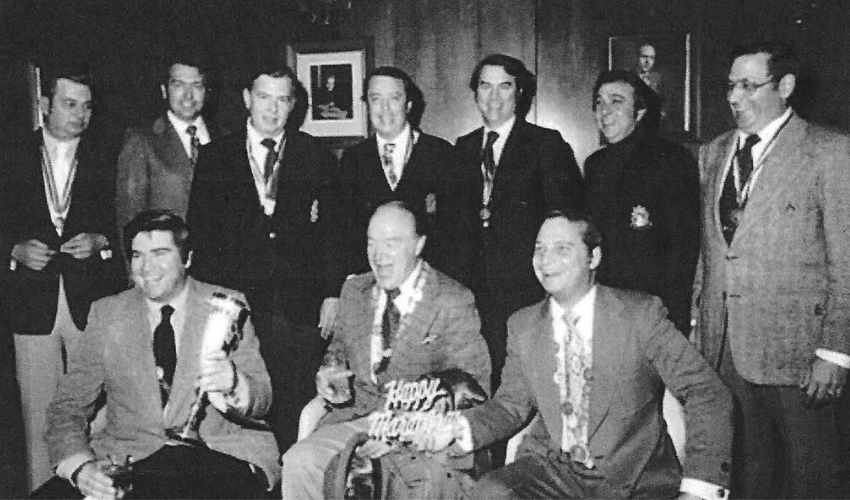
Bacchus Members
(Standing l to r) Marshall Pearce, Roland Hymel, Harold Spaid, Larry Youngblood, Billy Connick, Tony Fazola, Pete Moss; (Seated l to r) Dick Brennan, Bob Hope, Pip Brennan

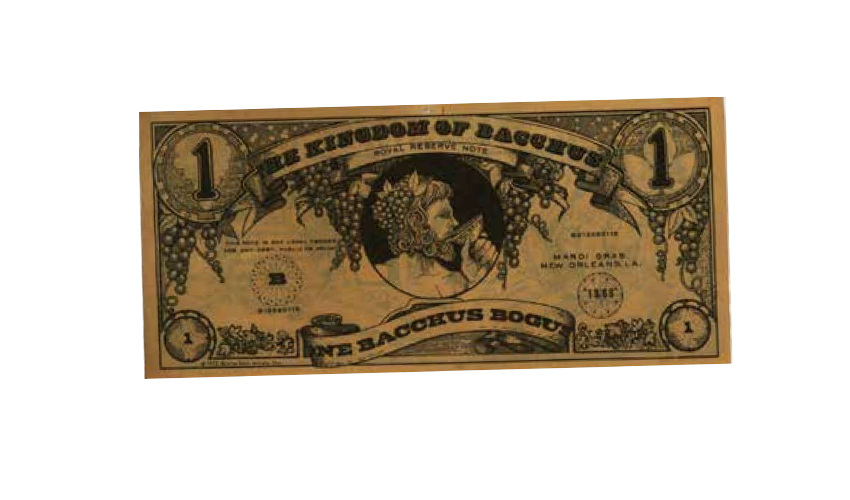
A new throw the Krewe unveiled that year was the Bacchus Bogus Bucks—a parchment bill enclosed in a plastic capsule with the image of Bacchus and the words “Royal Reserve Note.”

At age 69, Bob Hope, a personal friend of the Brennans, reigned as Bacchus V. Bob Hope recalled that Bacchus officials had “talked to me off and on about it for the last couple of years and actually my wife had a lot to do with my accepting it because I’ve told her about New Orleans…I loved New Orleans and the fun I’ve had.” Bob had in fact been invited to reign as Bacchus on more than one occasion, but Bacchus Sunday often conflicted with his Desert Golf Classic. Captain Emeritus Pip Brennan recalled that his Dad was good friends with Hope and would regularly send French bread from the restaurant to Bob and Dolores.

For Bacchus, Hope did a television special The Bob Hope Show: Springtime in New Orleans around Bacchus and Carnival that included Phil Harris Bacchus IV, New Orleans trumpeter Al Hirt, and future Bacchus XII clarinetist Pete Fountain. The show was viewed by five million people. Mayor Moon Landrieu thanked Bacchus for the positive image the city gained in the national telecast. Co-Captain Pip Brennan said, “We feel that we had really accomplished one of our main goals—to share the happy story of Carnival with the country.”

Upon arrival in New Orleans, Hope was greeted by Bacchus officials and the Olympia Brass Band and hundreds of well wishers at the New Orleans International Airport. Hope danced a traditional New Orleans second line with an umbrella while tossing doubloons. Hope exclaimed, “Hey, this is fantastic…You people do this every day?”

A new throw the Krewe unveiled that year was the Bacchus Bogus Bucks—a parchment bill enclosed in a plastic capsule with the image of Bacchus and the words “Royal Reserve Note.”

At age 69, Bob Hope, a personal friend of the Brennans, reigned as Bacchus V. Bob Hope recalled that Bacchus officials had “talked to me off and on about it for the last couple of years and actually my wife had a lot to do with my accepting it because I’ve told her about New Orleans…I loved New Orleans and the fun I’ve had.” Bob had in fact been invited to reign as Bacchus on more than one occasion, but Bacchus Sunday often conflicted with his Desert Golf Classic. Captain Emeritus Pip Brennan recalled that his Dad was good friends with Hope and would regularly send French bread from the restaurant to Bob and Dolores.

For Bacchus, Hope did a television special The Bob Hope Show: Springtime in New Orleans around Bacchus and Carnival that included Phil Harris Bacchus IV, New Orleans trumpeter Al Hirt, and future Bacchus XII clarinetist Pete Fountain. The show was viewed by five million people. Mayor Moon Landrieu thanked Bacchus for the positive image the city gained in the national telecast. Co-Captain Pip Brennan said, “We feel that we had really accomplished one of our main goals—to share the happy story of Carnival with the country.”

Upon arrival in New Orleans, Hope was greeted by Bacchus officials and the Olympia Brass Band and hundreds of well wishers at the New Orleans International Airport. Hope danced a traditional New Orleans second line with an umbrella while tossing doubloons. Hope exclaimed, “Hey, this is fantastic…You people do this every day?”

Mission accomplished. Bacchus would become the standard by which future krewes would be gauged.

Bacchus, The Golden Anniversary

by Robert Cangelosi, Jr.
Float 4 “Gone with The Wind” in front of Gallier Hall, 1973

An arrival party was thrown at Adelaide Brennan’s house on Prytania Street where Hope entertained those assembled. Lynne Brennan recalled Hope’s wife’s contribution to the party saying, “Dolores Hope had the most beautiful voice and she sang all night with the band.” Following a lunch at Brennan’s, Hope danced a soft-shoe routine with a group of street musicians on Royal Street. Poking fun at his predecessor Bacchus IV, Phil Harris, Hope joked, “If he was king last year, it will probably be refreshing to see a king sitting up”—a jab at Harris’s drinking persona. Harris would ride in the parade and the States Item reported, “Not far behind (Hope) was Phil Harris doing his best to upstage his old friend.”

Bacchus costume designer Larry Youngblood observed that Hope knew more about costumes than any previous Bacchus, remarking, “Bob Hope was well-versed on dressmaker terms. He wanted his costume cut for comfort. ‘Be careful to get the gussets right’ he continued, ‘I want to have plenty of room for movement’.” Youngblood would note in 1987 that “celebrities are easier to work with than some of these locals. They take it (Carnival) all so seriously, but I don’t. Mardi Gras is supposed to be fun.” Edith Head was Hope’s costumer, and she told him that Danny Kaye had loved his outfit. Peter Moss purchased Hope’s headpiece in Europe. The rhinestones and teardrop stones in his silver tunic were also purchased in Europe.

An arrival party was thrown at Adelaide Brennan’s house on Prytania Street where Hope entertained those assembled. Lynne Brennan recalled Hope’s wife’s contribution to the party saying, “Dolores Hope had the most beautiful voice and she sang all night with the band.” Following a lunch at Brennan’s, Hope danced a soft-shoe routine with a group of street musicians on Royal Street. Poking fun at his predecessor Bacchus IV, Phil Harris, Hope joked, “If he was king last year, it will probably be refreshing to see a king sitting up”—a jab at Harris’s drinking persona. Harris would ride in the parade and the States Item reported, “Not far behind (Hope) was Phil Harris doing his best to upstage his old friend.”

Bacchus costume designer Larry Youngblood observed that Hope knew more about costumes than any previous Bacchus, remarking, “Bob Hope was well-versed on dressmaker terms. He wanted his costume cut for comfort. ‘Be careful to get the gussets right’ he continued, ‘I want to have plenty of room for movement’.” Youngblood would note in 1987 that “celebrities are easier to work with than some of these locals. They take it (Carnival) all so seriously, but I don’t. Mardi Gras is supposed to be fun.” Edith Head was Hope’s costumer, and she told him that Danny Kaye had loved his outfit. Peter Moss purchased Hope’s headpiece in Europe. The rhinestones and teardrop stones in his silver tunic were also purchased in Europe.

Stop The Parade!

A Royal Bathroom Stop

1973 Bacchus DoubloonJust prior to the parade, Hope enjoyed golf at the New Orleans Country Club arriving just in time to don his royal wardrobe at the Rivergate, board his royal float, and lead the parade.

Float builder Blaine Kern remembered a problem that occurred during Hope’s reign. “Bob Hope stopped the whole parade because he had to go to the bathroom. Kern said to Hope, ‘Bob, you can’t stop the parade.’ Hope whipped back, ‘If you don’t stop the parade, I’m going to wet my royal pants’.” The parade stopped at the Jung hotel on Canal Street for a royal bathroom stop. The crowds assumed Hope went into the hotel to toast a VIP. Hope would make fun of his royal bathroom stop in later years on The Tonight Show.

In 2017, long time board member, Dr. Herb Marks, recalled that before he was a Bacchus member he really wanted to see Bob Hope, but he was on duty at Charity Hospital, and went AWOL in his green scrubs to see Hope on Canal Street. “I got to see him and I scurried back and no one knew I had snuck out. I got away with it. I could have been fired. I could have ended my career, but I wanted to see Bob Hope.”
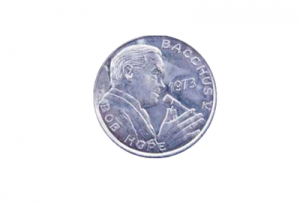
1973 Bacchus DoubloonJust prior to the parade, Hope enjoyed golf at the New Orleans Country Club arriving just in time to don his royal wardrobe at the Rivergate, board his royal float, and lead the parade.

Float builder Blaine Kern remembered a problem that occurred during Hope’s reign. “Bob Hope stopped the whole parade because he had to go to the bathroom. Kern said to Hope, ‘Bob, you can’t stop the parade.’ Hope whipped back, ‘If you don’t stop the parade, I’m going to wet my royal pants’.” The parade stopped at the Jung hotel on Canal Street for a royal bathroom stop. The crowds assumed Hope went into the hotel to toast a VIP. Hope would make fun of his royal bathroom stop in later years on The Tonight Show.

In 2017, long time board member, Dr. Herb Marks, recalled that before he was a Bacchus member he really wanted to see Bob Hope, but he was on duty at Charity Hospital, and went AWOL in his green scrubs to see Hope on Canal Street. “I got to see him and I scurried back and no one knew I had snuck out. I got away with it. I could have been fired. I could have ended my career, but I wanted to see Bob Hope.”

Bacchus is A Star!

At four years old, Bob Hope immigrated to the United States and by age eight was earning money by singing, dancing, and comedy patter. Silent film movie star Fatty Arbuckle first got Hope a job in vaudeville and his movie career began in 1934. Hope’s movie career spanned 38 years from 1934 to 1972, during which time he appeared in 70 movies. Hope is best known for his comedies such as My Favorite Brunette with Dorothy Lamour and the seven Road movies made from 1940 to 1962. In the comedy The Big Broadcast of 1938 Hope introduced his trademark song “Thanks for the Memory.” What else would Bacchus’s theme be for Bob Hope’s reign other than Bacchus Goes to the Movies. Hope hosted 14 Academy Award shows between 1939 and 1977.

Often Bob Hope appeared on Broadway at night while filming during the day. Most importantly, Hope was willing to go anywhere to entertain American troops. He starred in 57 USO tours from 1941 to 1991. In 1950 Hope migrated to television and in 1954 had a regular special. Hope’s Christmas specials were very popular and his 1993 special Bob Hope: The First Ninety Years won an Emmy.

Hope, who had a brief career as a boxer was an avid golfer, founding The Bob Hope Chrysler Golf Classic in 1960. His first wife was Grace Troxell and his second wife was Dolores Hope from 1934 until his death. Hope adopted four children.

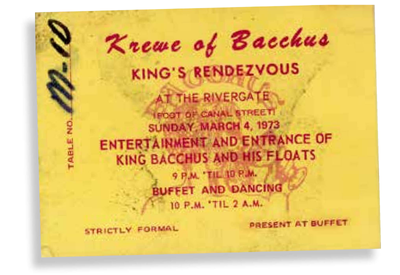
For the 1973 Rendezvous at the Rivergate, Bacchus board member Blaine Kern invited Ed Muniz, Captain of the Krewe of Endymion, to partake of the entertainment. At the time, Endymion was a small Gentilly neighborhood parade, renting floats from the Krewe of Carrollton and staging a tableaux ball. Muniz recalled, “It was magical. I was impressed. I told Kern, ‘I really like what they’re doing’.’’ As a result, Endymion would grow to be the city’s second super krewe with a post parade party at the Rivergate in lieu of a tableaux ball.

Bacchus Currency

The Bacchus Bogus Buck, the first in a series of five, was tossed from the floats in plastic tubes.